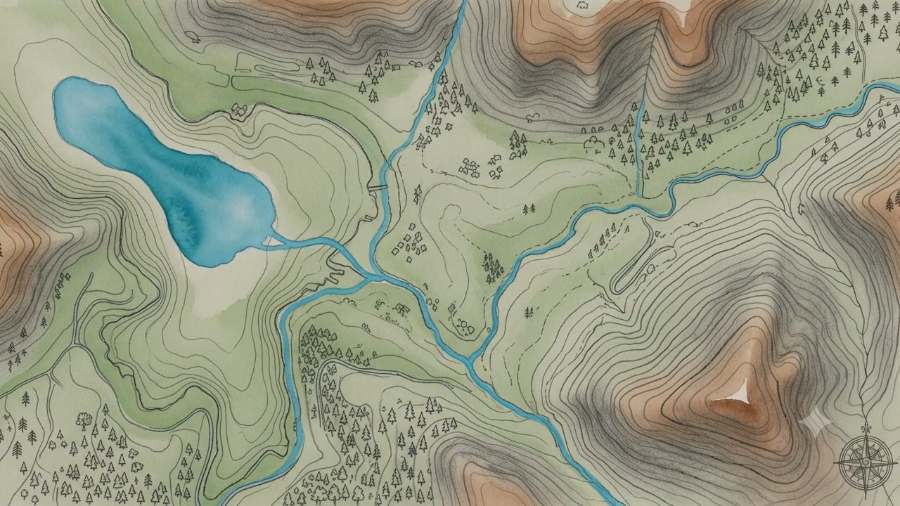


Boardrooms make maps. The strategy deck, the workflow diagram, the org chart, the KPI dashboard — these are useful, and they are abstractions that omit, by design, almost everything that makes the territory function.
A workflow diagram cannot show you which handoff is actually held together by a long-running informal relationship between two people in different departments, without which the process would seize. The dashboard cannot show you that a metric has been gamed in seventeen small ways by a team keeping their reviews positive while doing the work they actually believe in. None of this is hidden. It is simply invisible to the map.
When interventions are designed from the map, they are designed for an organization that does not exist. What arrives looks like resistance. From the ground, it is the workforce keeping things running despite a plan that did not account for them. The obstacle is not the territory. It is the gap between map and ground — bridged by people who can hold the map and walk the terrain at the same time.
The distinction is not one we borrowed. The Better Part, our founder’s account of twenty years inside the world’s first fair trade clothing network, follows a project whose planners held the map while its members walked the ground. It closes on the project’s own director, decades in, arriving where every honest mapmaker eventually arrives: “walking terrain he once only mapped.”
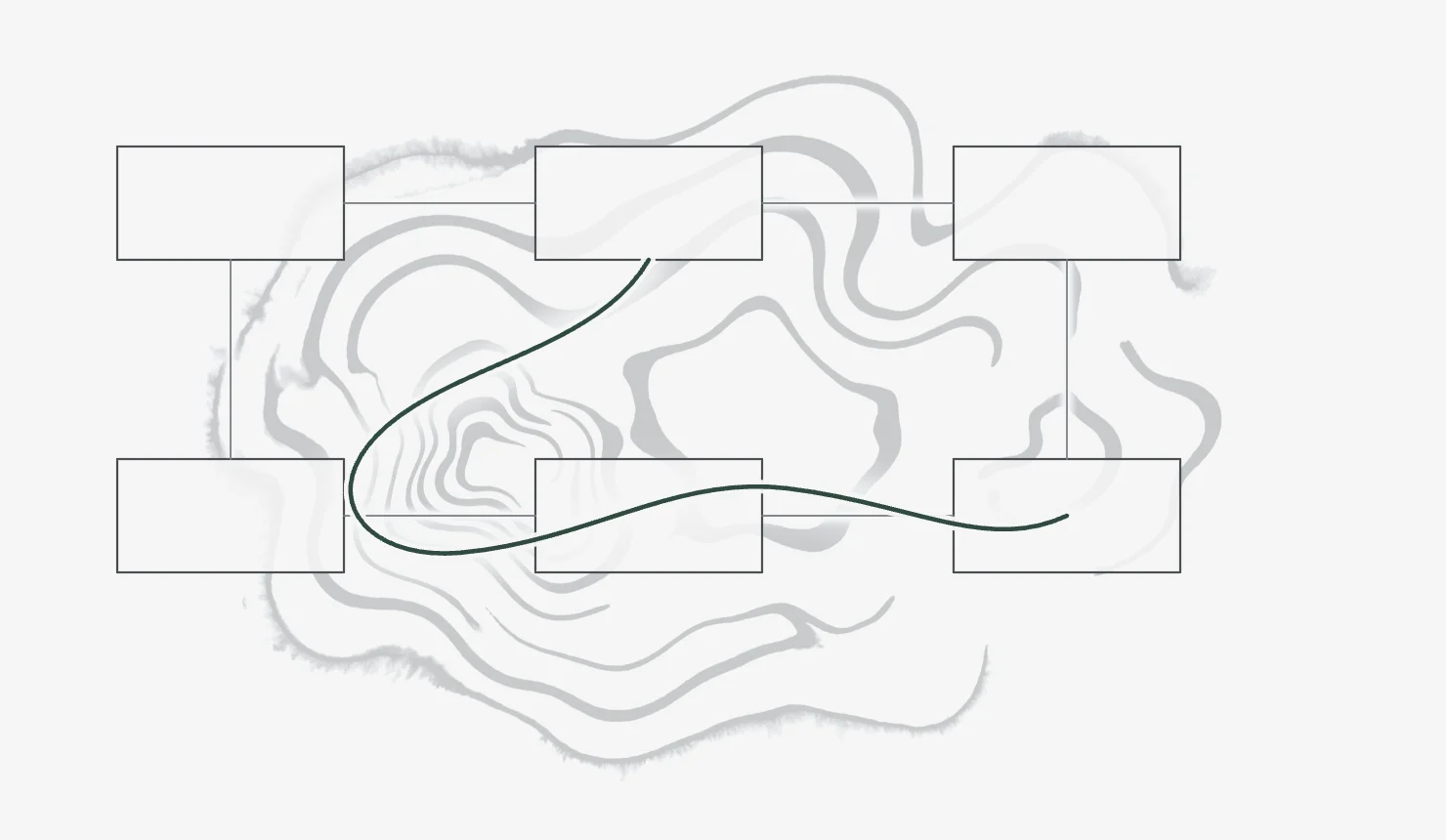
The two instruments we put down
The first instrument is the view from above. Give a team enough cameras and a satellite map and the promise is totality: every image pinned to its point, the whole place legible at a glance. What comes back is the cliché the team went there to escape, and a map that cannot read the place. The view from above delivers one discovery reliably. A place is not where it is. It is how it is read.
The second instrument is the compass. Come down off the map and reach for one, and the error is subtler and slower to see. A compass is issued to a person and consulted alone: the altitude is corrected, the solitude kept. And the needle never points one way. It is a single object with two ends, offering north and south in the same gesture. North is not given by the magnet. North is the end everyone has agreed to read.
What replaces them is not a third instrument. The people this method was learned among had a name for it, and the field did not: tomar conciencia. Not “becoming aware” but taking it, closer to an ethical attentiveness than to information. A way of attending that is partial by nature, that holds both readings of the same picture without deciding between them, and that cannot be done alone.
Engineering distinguishes static friction from kinetic friction. Static friction is what holds a tire to the ground — without it the wheel spins and the bicycle does not move. Kinetic friction dissipates energy once motion begins. Most consulting treats organizational friction as though it were only kinetic: drag to be minimized. That misreads the drag, which usually contains the feedback needed to steer.
The clearest case is the workaround. A team meets a process that does not work under their actual operating conditions. They do not stop working. They adapt. From above it looks like deviation. From the ground it is the organization’s immune system, and it is evidence about what the official process gets wrong.
A workaround is data.
One condition governs all of this. A workaround is legible as data only if the person who developed it can describe it without fear. This is why confidentiality is not a courtesy we extend to your employees against you. It is the precondition for the organization to perceive itself at all.
An overinflated bicycle tire bounces off uneven ground. It loses grip, jars on impact, and wears the rider down. A tire that yields to the terrain — that deforms around the cobblestones, absorbs the shocks, and keeps its connection to the ground — is the one that moves forward, and moves faster. Friction is not the opposite of momentum. It is the precondition. The first bicycles rode on iron and solid rubber; riders called them boneshakers. Then Dunlop wrapped air in a casing soft enough to yield — he built it for a child’s tricycle — and the pneumatic tire started winning races.

Petrichor is what rises when rain first hits dry ground, and it is one of the hardest scents in the world to manufacture. Geosmin is not residue lying inert in the ground. Soil bacteria make it — it is a product of their own life cycle, generated continuously whether or not anyone is there to smell it. When the first drops land on porous earth, the impact traps pockets of air that shoot upward and burst, carrying it above the surface. The rain does not create the compound. It makes it perceptible to someone standing above the ground.
That is the more exact description of what happens when a new strategy meets an operation. The accumulated knowledge of your workforce — the survival strategies, the workarounds, the lived experience of what happens when policy meets practice — is geosmin, and it was already being produced. The new strategy is the rain. What the impact changes is not the ground; it is what can be perceived from above it.
And the scent cannot be caught on its own. In Kannauj, where the smell of first rain has been distilled for centuries, baked clay is heated in a copper vessel and the vapor is carried into a receiver that already holds sandalwood oil — without the oil sitting there first, the volatiles condense and disperse and nothing is captured. What comes out is not a pure essence. It is a compound: part earth, part sandalwood. Anyone who tells you they can extract your organization’s intelligence without becoming part of what they extract is describing something that does not exist.
The hotter and drier the clay, the richer the scent when the rain finally comes. The same is true of an operation that has gone a long time without anyone asking.
We map the soil. Before an intervention lands, we conduct embedded research into how the work actually gets done: local knowledge, historical memory, workarounds, informal authorities, unspoken norms. This is not a culture assessment. We do not arrive with the diagnosis already written.
We are present at impact. When the new strategy lands, we embed with the teams receiving it — not at the leadership level, where impact is already mediated by reporting, but where the tire meets the cobbles. The first ninety days of impact contain more strategic information than the eighteen months that follow.
We aerosolize. Released intelligence does not stay in the air for long. We translate it — quickly, accurately, and in language leadership can act on — into operational policy that integrates rather than overrides.
We return findings to the floor. Findings go back to the teams they came from before they reach leadership, and those teams may argue with them. Nothing travels upward that the people it describes have not seen.
Picture it as one moment. You are riding through the city when the first rain comes — the real rain, on stone still warm from the day. The smell rises off the pavement at once, sharp and green and clean: the heat breaking, the porch in the evening, the clouds finally giving texture to a bleached and indifferent sky. The cobbles darken and turn slick, and you feel every one of them come alive through the tires. The road beneath you is both built and natural — laid stone and living ground — and the scent is what rises where the two meet.
This is the experience the practice is named for: what is released when something new arrives on ground that was already there.
“A model that travels is a design; an economy that lives is a place.”
— The Better Part

We are present alongside your teams for the duration of a transition, as working participants rather than observers or auditors. The model is closer to applied anthropology than to management consulting: studying with people rather than studying them. The deliverable is not just a report. It is the change, and the documentation that allows the change to hold.
This has consequences. We will not produce a strategy in isolation and hand it to your team. We will not substitute for your internal change management function — we work alongside it, build it where it does not exist, and leave it stronger than we found it. We will not stay longer than we are needed.
The goal of an embedded engagement is to make ourselves unnecessary.
The methods have been running in both directions for over a decade. Classroom methods — the jigsaw, the fishbowl, the Café Mundial — were carried into experimental ethnographic workshops in Nicaragua, where fixed learning objectives became open questions; methods learned there from Nicaraguan teacher-scholars were carried back into university classrooms. This practice is the third leg of that circuit.
The tradition behind this posture has a name: accompaniment. It comes from the communities documented in The Better Part — people who stood beside others on war lines long before anyone held a pen or kept a ledger. Accompaniment walks beside; lends what protection its privilege carries; does not hold the pen; stays. Administration and accompaniment are not points on a spectrum. They are opposed forms of labor — the first refuses the separation of conception from execution that the second is made of — and the design of an embedded engagement is, in the end, a set of guarantees that we stay on the right side of that line.
A note on the images
The drawings on this site are made in the manner of suminagashi, the Japanese art of floating ink on water and lifting the pattern onto paper. The oldest written reference to the practice is a waka:
Mizukuki no
ato o mizu ni mo
nagasenba
kaki todomubeki
koto no ha mo nashi
If the traces of the brush
are allowed to float away upon the water,
there will be no words left
to write down and preserve.
— Minamoto no Morotada (1054–1114), recorded in Einen Miura, The Art of Marbled Paper (Kodansha International, 1991)
The poem worries that what forms on the water will drift apart before anyone can keep it. The marbler’s answer is to lay a sheet on the surface and lift the moment off whole. Some of the oldest surviving copies of the Kokin Wakashū, the tenth-century anthology of Japanese poetry, were written on paper preserved this way. That is our practice in one gesture. What an organization learns in the friction of change surfaces briefly and is gone unless someone is there to take the print. The lines that run through these pages are drawn as level sets of a single ground, so no two of them cross, and the floated ink is the same ground, caught while it moved.
Like any fleeting event or change of state, no two of these figures could be made twice. The currents and eddies, the ink, the temperature of the water are never the same. Some prints are complex and some are simple. Some converge and others diverge. We do not mistake the image for the process that made it, and we would not ask an organization to either.