If you want to understand what we believe and how it shapes our work, this is for you. It is longer than the manifesto and more demanding, precisely because it draws openly on twenty years of fieldwork; education at the highest tiers in the anthropology of organizations, labor, policy, and ecology; peer-reviewed research; and demonstrated practice. We make no attempt to disguise the intellectual lineages of our method, because those lineages are the point. There is a real shortage of practitioners who have spent two decades finding better ways to do the work.
The names that appear here — anthropologists, geographers, and geologists, alongside economists, policymakers, and philosophers of science — appear because their work has been load-bearing in the development of our method, not as a performance of credentials. Readers who want the citations will find them in the published research behind this practice. Readers who want the operational consequences of the thinking will find them here.




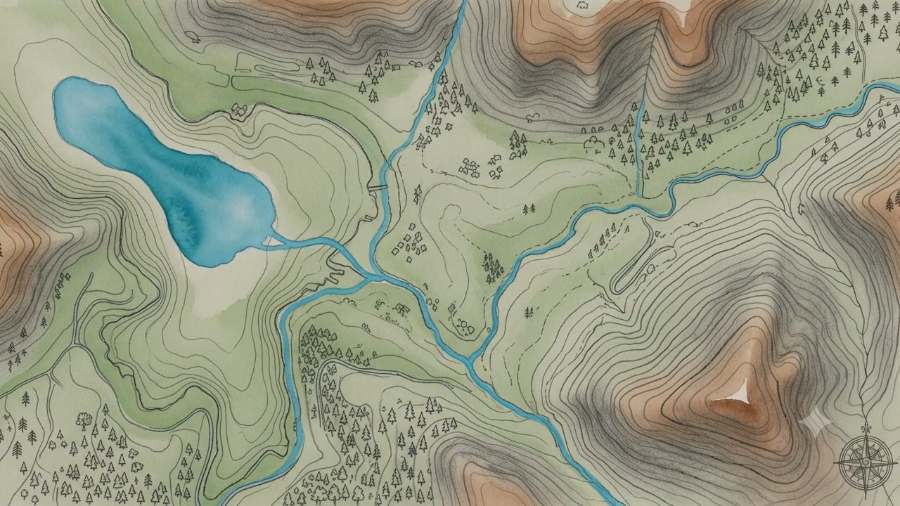
The phrase “the map is not the territory” comes from Alfred Korzybski, and it has been borrowed so often that it has lost most of its bite. The original point was epistemological: any representation of a thing is necessarily a reduction of the thing, and confusing the two is a category error that produces predictable failures.
In organizational consulting, this category error often comes down to the operating model. The strategy deck, the workflow diagram, the org chart, the KPI dashboard — these are maps. Like blueprints, they are useful. They are also abstractions that omit, by design, almost everything that makes the territory function. A workflow diagram cannot show you which of three handoffs in a process is actually managed by a long-running informal relationship between two people in different departments, without which the workflow would seize. The org chart cannot show you that one of the lines on it is a person whose authority extends well beyond their title because they were there when the building was built. The KPI dashboard cannot show you that the metric you are measuring has been gamed in seventeen small ways that the team developed over four years to keep their reviews positive while doing the work they actually believe in.
None of this is hidden. It is simply invisible to the map.
When consultants design interventions from the map, they design for an organization that does not exist — or at least one they do not know very well. The intervention arrives in the actual organization and produces what looks like resistance. From the boardroom, this looks like a problem with the workforce. From the territory, it looks like the workforce performing its usual function: keeping things running despite a plan that did not account for them.
Our starting point is that the territory is not the obstacle. The map is the obstacle. Or more precisely: the obstacle is the gap between them, and that gap is bridged not by better maps but by people who can both hold the map and walk through the territory. This is not a romantic claim about the wisdom of the worker. It is an empirical claim about where the operational intelligence of an organization actually resides, supported by a substantial body of research on labor, knowledge, policy, and practice across two decades and several continents.

Engineering distinguishes between static friction and kinetic friction. Static friction holds a tire in place on the ground — without it, the wheel spins but the bicycle does not move. Kinetic friction dissipates energy once motion begins — too much and the rider does the work twice, none and you can neither steer nor brake.
Most consulting treats organizational friction as if it were only kinetic: a drag on motion to be minimized. This is wrong in both directions. It misses the productive role of static friction (the local knowledge that gives a strategy purchase in the first place) and it misreads the kinetic friction itself (which often contains the very feedback needed to steer).
The clearest expression of this is the workaround. When a team encounters a process that does not work for their actual operating conditions, they do not stop working. They adapt. The adaptation usually happens informally, gets passed along by demonstration, and never appears in any document. From above, this looks like deviation. From the ground, it is the organization’s immune system. It is also, crucially, empirical evidence about what the official process gets wrong.
A workaround is data.
The standard consulting response to discovered workarounds is to eliminate them or codify them. Both responses miss the more interesting move: asking why the workaround was needed, what the workforce learned in developing it, and what it reveals about the larger system. Anna Tsing’s “arts of noticing” is relevant here — the question is not whether the workaround should exist but what it is telling you, and what kind of attention is required to hear it.
There is a condition on all of this that is easy to miss. A workaround is only legible as data if the person who developed it can describe it without fear. An organization that disciplines the messenger does not thereby stop the workarounds; it stops hearing about them, and loses the signal while keeping the problem. This is why the confidentiality of our method is not a courtesy extended to employees against their managers. It is the precondition for the organization to perceive itself at all.

We named our methodology after petrichor because the phenomenon does a precise piece of conceptual work that we needed and could not find elsewhere.
A great deal of consulting language is mechanical: levers, switches, drivers, pipelines. The metaphors are industrial, presuming an organization can be operated on the way a machine can — disassembled, fixed, reassembled. A great deal of academic language about organizations, in compensation, is biological: ecosystems, cultures, organisms. The biological metaphors are richer but tend toward the holistic and the slow. Neither family quite fits what actually happens in a transition.
Petrichor sits between them. It is a chemical phenomenon — geosmin is a real molecule, the bubble-burst mechanism mechanically describable — but the phenomenon itself is emergent, relational, and impossible to produce by component. You cannot synthesize petrichor by combining its ingredients. You can only create the conditions for the interaction and let the reaction happen.
This matches twenty years of fieldwork in workplaces, factories, cooperatives, municipalities, and global supply chains. Organizational change is not a mechanical operation, and it is not purely an organic process either. It is a reaction between accumulated local knowledge and the kinetic force of intervention. The intervention does not create the change. The accumulated knowledge does not produce the change on its own.
The change is the reaction.
Isabelle Stengers’ “ecology of practices” is the closest thing in the theoretical literature to what we do operationally: a way of holding multiple modes of expertise — institutional, operational, regulatory, local, tacit — in productive relation without collapsing them into a single hierarchy. It is what Proyecto Buen Vivir built, an NSF-funded research project in Ciudad Sandino, Nicaragua, where twelve experimental workshops, with a cohort of forty residents, brought informal-sector recyclers, social workers, public-health officials, and educators together around shared operational problems. Those workshops did not produce consensus. They produced what Marisol de la Cadena and Mario Blaser call an “uncommons” — a working relationship between perspectives that remain genuinely different. That is the model. It is what we now bring to organizations in transition.

The word “embedded” is overused in consulting. We use it advisedly, with a specific meaning: we are physically and operationally present alongside client teams for the duration of a transition, not as observers or auditors but as working participants. The model is closer to applied anthropology than to management consulting — studying with people, in Tim Ingold’s phrase, rather than studying them. The deliverable is not just a report. It is the change, and the documentation that allows the change to hold.
Embedded practice also implies a particular ethical stance, which we take from María Puig de la Bellacasa’s work on care as a methodology rather than a sentiment. To work in care, in this sense, is to take seriously the obligation to the people whose work and knowledge make a transition possible — to refuse to treat them as inputs or as resistance, and to recognize that the relationships built during an engagement carry forward in ways the engagement cannot control. It shares a spirit with accompaniment — the Nicaraguan health tradition of the promotores, carried into global health by Paul Farmer: walking with rather than directing, staying until the work holds.
This has implications for what we will and will not do. We will not produce a strategy in isolation and hand it to your team. We will work with your leadership to develop strategy, and with your teams to land it — helping different parts of an organization to better trust one another along the way. We will not be a substitute for your internal change management function; we will work alongside it, build it where it doesn’t exist, and leave it stronger than we found it. We will not stay longer than we are needed.
The goal of an embedded engagement is to make ourselves unnecessary.
The Better Part documents the limit case. A fair trade network built instrument after instrument to hold its relations in place — contract, label, memo, seal — and every one of them was calibrated: set against a standard that arrived from outside, and checkable only back against it. None was ever tuned. None could be handed back changed by the people who had to work inside it. The instruments were not the problem. An instrument nobody can tune is. The network automated the adjustment and lost it. The women kept the verb.
It would be dishonest to present this practice as neutral. It is not. No organization is a value-neutral entity; every organization is a site where people are constantly deciding whose knowledge counts, whose labor is recognized, whose futures are imagined — and whose are not.
We believe in equity, sustainable change, and ethical practice — in short, in taking real steps toward a better world. We bring that framework into client engagements because it produces better operational outcomes, not because we are trying to convert anyone. Organizations that treat frontline knowledge as data rather than noise outperform organizations that don’t, on the dimensions their own boards care about. Organizations that build genuine consent into a transition spend less remediating it later. Organizations that take seriously what sustainability actually requires of their operations — rather than what it requires of their reporting — produce more durable transitions and lose fewer good people along the way.
We believe you can do well by clients, stockholders, employees, future generations, and the world without contradiction. We are not in the business of telling clients what they should believe — we oftentimes learn from them, sharpening our own ethical lens in the process. We are in the business of helping them do what they have already decided to do, in ways that actually succeed. Where our framework diverges from theirs, we say so. Where it cannot converge — when an organization is unwilling to take its own workforce seriously as a source of intelligence — we generally don’t take the engagement. Both sides are better served.

Consulting outcomes are usually measured in deliverables: number of reports, number of recommendations, number of slides. We measure differently.
The first outcome we look for is whether the change held. Six months after our engagement closes, is the new practice still in place? Has it been quietly reverted, formally rolled back, or genuinely absorbed? This is the only outcome that ultimately matters, and it is the one most consulting engagements never measure because the firm has already moved on.
The standard is not abstract. In Ciudad Sandino, communities dug their own sanitation infrastructure, planted a thousand trees, built eight community gardens, and constructed a free clinic that employs six full-time doctors. Ella Jae Fisher served as a board member of the organization that accompanied that work, and as technical director of its workshops. None of it was built for them. What that role structured was the process through which people surfaced what they needed to succeed — and the clinic holds because the people who run it designed it.
The second is whether the organization learned something durable. Did the engagement build internal capacity to do the next transition without us, or did it create a dependency? Embedded practice that produces dependency is a failure mode we are vigilant about.
The third is whether the relationship between strategy and operations changed. The most useful long-term outcome of a well-executed engagement is that leadership comes to trust operational signal differently — to read workarounds as data, to take frontline observations seriously as strategic intelligence, to ask different questions of the territory. When that shift happens, it compounds across every transition the organization faces afterward.
Merit is unrelated to potential. One looks back at what has been recorded; the other faces forward at what has not happened yet. In an organization the teams carrying the worst numbers are often the ones absorbing the most structural friction — which is to say the record is not a transparent reflection of capacity, especially where someone’s experience of the system has been roadblock after roadblock.
The final accounting in The Better Part reads: “The goods failed and the people compounded — and if your economics has no column for that, the deficiency is in the economics.” That is the ledger we keep.

On what good analysis does
Good analysis unsettles the foundations of what you thought you already knew. For a while you may know less than when you started, and be wiser for it. Across sixteen years of teaching, that discomfort consistently did not deactivate learning. It activated it.
What we will not do is show you that the world is broken and stop there. The point of looking hard at something is to find the openings in it.

Sustainability transitions are the largest organizational change project of our lifetimes. Under CSRD, ESRS, and a growing array of regulatory and stakeholder pressures, European companies are now required to demonstrate not just that they have measured their impact but that they are actually changing how they operate. The reporting industry around this is large and growing. The implementation gap is larger.
Most companies treating CSRD as a reporting exercise will produce a compliant first report and discover, in year two, that the report has not changed anything. The metrics will drift. The targets will slip. The board will lose patience. By year three, the strategy will be quietly relegated to the sustainability function, and the operational reality will not have moved.
This outcome is avoidable. It requires recognizing that sustainability is not a reporting category. It is an operational transformation that touches every part of the business, and it succeeds or fails in the terrain, not the deck.
Energy Ecologies exists for the companies that are serious about not failing this transition. We are not the largest firm. We are not the cheapest.
We are the practice that will be there when the tire meets the cobbles, and we will help you build the traction to keep moving.
A vocabulary can be adopted with surprising ease, and the ease is itself worth attending to. An organization practices its own version of this when it acknowledges the problem, gestures at other ways of working, and then declines the harder conversation about what would actually have to change. The language arrives. The operation does not move. That gap is the whole of our work.
We hold this position for reasons that predate CSRD. Ella Jae Fisher spent twenty years inside a network that carried every instrument the compliance imagination has produced — charters, contracts, audits, a certification pilot — and by their own terms they worked. The cooperative passed its audits. Nothing failed: no fraud, no lax auditor, no bad actor. What none of the instruments could register was the thing its members had organized their working lives around, and no one had any way to hand an instrument back changed.